When you own shares in a company, you’re a part-owner. And owners are entitled to a share of the profits. How that profit reaches you — and whether it actually benefits you — depends on the method the company uses. On the DSE, companies return value to shareholders through three main channels: cash dividends, bonus shares, and rights issues. Each works differently, and understanding the differences is essential.
Cash Dividends
A cash dividend is the most straightforward form of shareholder return. The company sends you actual money, deposited directly into your bank account linked to your BO account.
How They Work
Dividends on the DSE are declared as a percentage of the face value (par value) of the share, which is ৳10 for most DSE stocks.
- A 20% cash dividend means ৳2.00 per share (20% of ৳10)
- A 100% cash dividend means ৳10.00 per share
- A 250% cash dividend means ৳25.00 per share
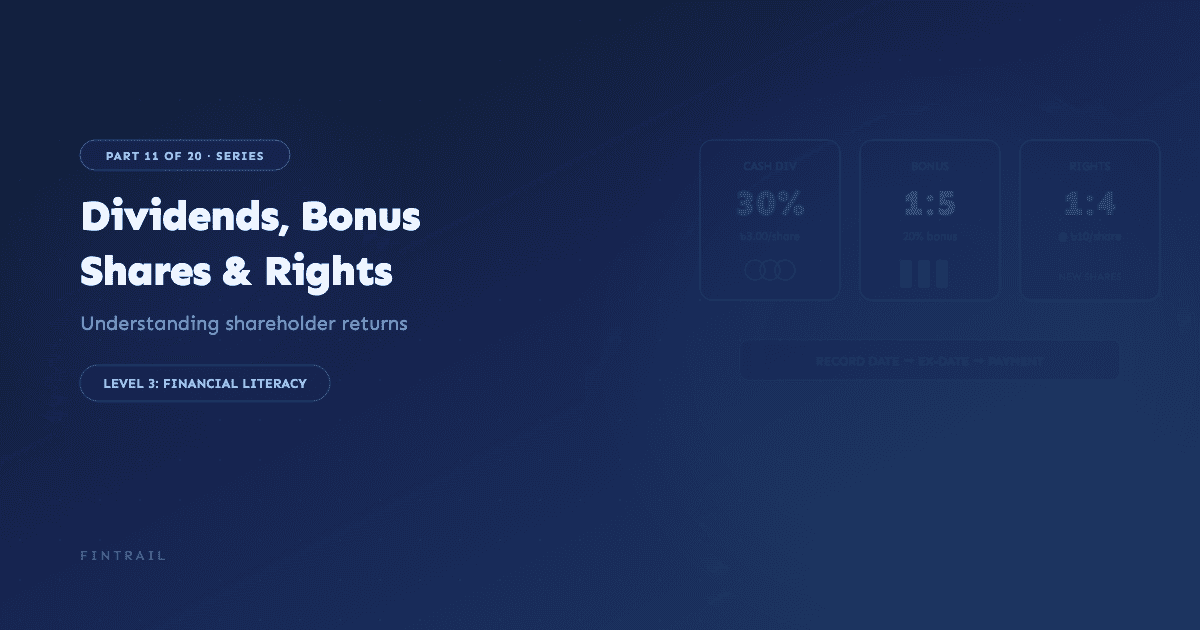
If you hold 500 shares of a company that declares a 30% cash dividend, you receive: 500 x ৳3.00 = ৳1,500.
Key Dates to Know
- Declaration date — The board announces the dividend and proposed amount
- Record date — You must be a shareholder on this date to receive the dividend. The CDBL (Central Depository Bangladesh Limited) checks ownership records on this date.
- Ex-dividend date — Typically two trading days before the record date. If you buy shares on or after this date, you won’t receive the dividend. The stock price usually drops by roughly the dividend amount on this date.
- Payment date — When the dividend is actually deposited into your bank account, usually within 30 days of AGM approval
Evaluating Dividend Quality
Not all dividends are created equal. Here’s what to consider:
- Dividend yield = Annual Dividend per Share / Market Price. A stock at ৳80 paying ৳4 per share annually has a 5% yield. On the DSE, yields between 3-6% are decent; above 6% is generous.
- Payout ratio = Dividends / Net Income. If a company earns ৳10 EPS and pays ৳6 in dividends, the payout ratio is 60%. Anything above 80% might not be sustainable — the company may not have enough left to reinvest in growth.
- Consistency — A company that has paid dividends every year for 10 years is far more reliable than one with an erratic history. Check whether dividends have been growing, stable, or declining.
- Can they afford it? — Compare dividend payments against cash flow from operations, not just net profit. A company might report profit on paper but not generate enough cash to actually pay dividends.
Tax on Dividends
In Bangladesh, dividends are subject to tax. Currently, a 10% withholding tax is deducted at source for individual investors if total dividend income exceeds ৳50,000 in a fiscal year. For amounts up to ৳50,000, the rate is lower. Tax rules change, so verify current rates with your tax advisor.
Bonus Shares
Instead of cash, a company can issue additional shares to existing shareholders. This is called a bonus issue (or stock dividend).
How They Work
A 10% bonus means you get 1 new share for every 10 you own. If you held 200 shares, you’d receive 20 additional shares, bringing your total to 220.
A 50% bonus means 1 new share for every 2 held. Your 200 shares would become 300.
The Crucial Truth About Bonus Shares
Here’s what many DSE investors misunderstand: bonus shares don’t increase your wealth. After a bonus issue, the stock price adjusts downward proportionally.
If a stock is at ৳150 and issues a 50% bonus:
- Before: 200 shares x ৳150 = ৳30,000
- After: 300 shares x ৳100 = ৳30,000
Your total value is the same. You just own more shares at a lower price. It’s like cutting a pizza into more slices — you don’t get more pizza.
When Bonus Shares Make Sense
Bonus issues aren’t entirely meaningless, though:
- They increase liquidity. A stock trading at ৳800 might be less accessible to small investors. After a bonus, the lower price attracts more buyers.
- They signal confidence. Companies typically issue bonuses when they’re retaining earnings for growth rather than distributing cash.
- They can create psychological momentum. The market sometimes reacts positively, though this is behavioral rather than fundamental.
But be careful: if a company issues bonus shares year after year without corresponding earnings growth, EPS gets diluted and the stock just drifts lower. Bonuses without growing profits are a red flag.
Rights Issues
A rights issue is when a company offers existing shareholders the right to buy additional shares at a discounted price, proportional to their current holdings.
How They Work
A company might announce: “1:4 rights issue at ৳15 per share.” This means for every 4 shares you own, you can buy 1 new share at ৳15 (instead of the current market price, which might be ৳60).
If you own 400 shares:
- You’re entitled to buy 100 additional shares
- Cost: 100 x ৳15 = ৳1,500
- After the issue, you’d hold 500 shares
Key Difference from Bonuses
Unlike bonus shares, rights issues require you to put in additional money. The company is raising capital — it needs funds for expansion, debt repayment, or regulatory requirements.
Should You Subscribe?
This is where it gets important:
- Why is the company raising money? Expansion into profitable areas is good. Plugging holes in the balance sheet is concerning. Raising capital to meet regulatory minimum capital is common for banks — acceptable but not exciting.
- What’s the discount? The deeper the discount to market price, the more attractive the rights. If the stock is at ৳60 and rights are at ৳15, the discount is substantial.
- Can you afford it? You don’t have to subscribe. But if you don’t, your ownership gets diluted. You can sell your rights entitlement to someone else in the market.
- Post-issue impact. More shares outstanding means EPS will decrease unless the company grows proportionally. Calculate the post-rights EPS to see if the valuation still makes sense.
Comparing the Three
| Factor | Cash Dividend | Bonus Shares | Rights Issue |
|---|---|---|---|
| Cash to you? | Yes | No | You pay cash |
| Changes total shares? | No | Yes (increases) | Yes (increases) |
| Affects EPS? | No | Yes (dilutes) | Yes (dilutes) |
| Your action needed? | None | None | Must decide to subscribe |
| Signal | Profit distribution | Retained growth | Capital raising |
Building a Dividend-Focused Strategy
If you’re building a portfolio for income, focus on companies that deliver consistent, sustainable cash dividends. For a practical guide on structuring such a portfolio, see our guide to building a diversified DSE portfolio.
Key principles:
- Prefer cash dividends over bonuses — cash is unambiguous value
- Look for companies with 5+ years of consistent or growing dividends
- Target a dividend yield of 4-6% combined with reasonable EPS growth
- Avoid chasing extremely high yields — they may signal a falling stock price rather than generous payouts
Dividends, bonuses, and rights all have their place. The informed investor understands each mechanism and makes decisions based on fundamentals, not excitement.
Think About This
- A company announces a 100% bonus share. The stock price rises 5% on the news. Does this reaction make fundamental sense, or is it purely behavioral?
- If a company has a payout ratio of 90%, what risks does this create — even if the dividend yield looks attractive?
- A bank announces a rights issue to meet new regulatory capital requirements. How would you decide whether to subscribe or sell your rights?