There is a popular image of the stock market as a place where fortunes are made in weeks. On DSE trading floors and in Dhaka’s brokerage houses, you hear stories of people doubling their money in a month. What you don’t hear are the stories of those same people losing it all the next month.
The reality is quieter and far more reliable: the investors who have built lasting wealth on the DSE are overwhelmingly those who bought good companies and held them for years. Let us explore why long-term investing works — especially in Bangladesh.
Why Bangladesh Is Built for Long-Term Investors
Bangladesh’s economy has averaged over 6% GDP growth for more than a decade. The country has gone from a low-income economy to a lower-middle-income one, with a rapidly expanding middle class, growing consumer spending, and massive infrastructure development.
This creates a tailwind that short-term traders cannot capture but long-term investors ride automatically. When you own shares in a bank that is lending to a growing economy, a pharmaceutical company serving 170 million people, or a cement manufacturer supplying a construction boom — time works in your favour.
The DSE has had its crises. The crash of 2010-11 is still fresh in collective memory. But investors who held quality stocks through that period and continued investing saw their portfolios recover and grow well beyond previous peaks. The market punishes impatience and rewards staying power.
The Power of Compound Growth
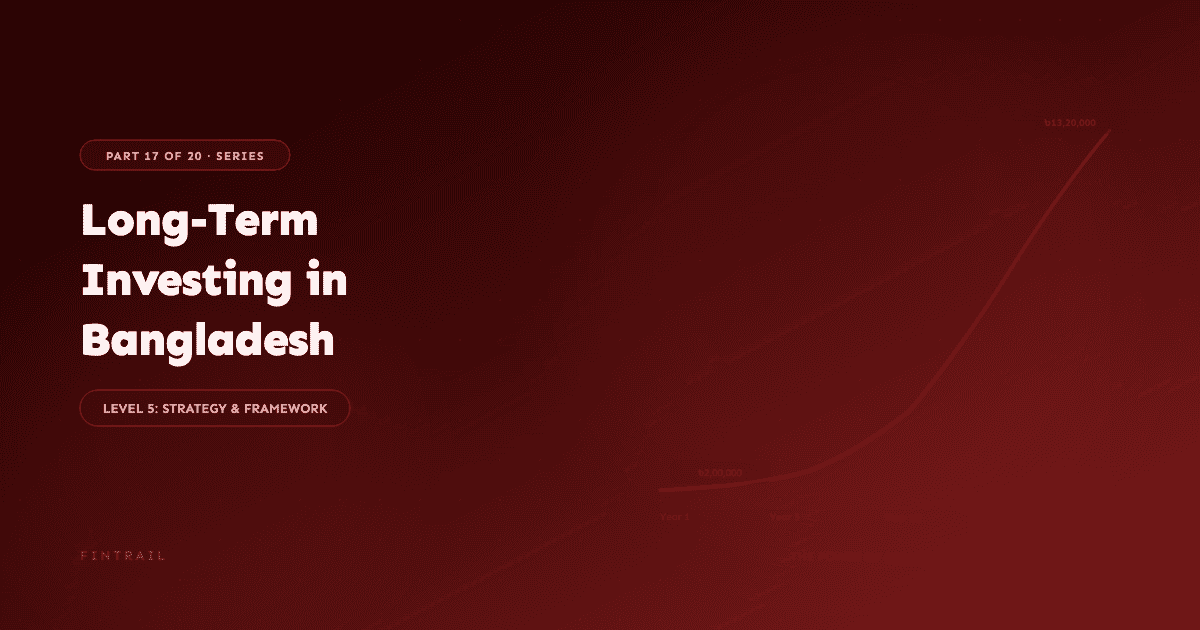
Compound growth is the single most powerful force in investing. It means your returns generate their own returns, creating an accelerating cycle of wealth creation.
Let us make this concrete with BDT numbers.
Scenario: Investing ৳10,000 per month
| Time Period | Total Invested | Value at 12% Annual Return | Value at 15% Annual Return |
|---|---|---|---|
| 5 years | ৳6,00,000 | ৳8,25,000 | ৳8,94,000 |
| 10 years | ৳12,00,000 | ৳23,23,000 | ৳27,86,000 |
| 15 years | ৳18,00,000 | ৳50,46,000 | ৳67,69,000 |
| 20 years | ৳24,00,000 | ৳99,91,000 | ৳1,51,59,000 |
Look at the 20-year column. At 15% annual return, you invest ৳24 lakh and end up with over ৳1.5 crore. More than ৳1.27 crore of that is pure profit — money your money earned for you. That is compounding at work.
And 12-15% annual returns are not fantasy numbers. The DSEX has delivered roughly this range over long periods, and individual quality stocks have done considerably better.
The SIP Approach: Disciplined Monthly Investing
In more developed markets, Systematic Investment Plans (SIPs) are a standard wealth-building tool. The concept is simple: invest a fixed amount every month, regardless of whether the market is up or down.
On the DSE, there is no formal SIP product for stocks, but you can create your own. Set aside a fixed amount — say ৳15,000 per month — and buy shares of your chosen companies regularly. Some months you will buy at higher prices, some at lower. Over time, this averages out your cost and removes the impossible task of timing the market.
Here is why this works:
- When the market falls, your ৳15,000 buys more shares at cheaper prices
- When the market rises, your existing shares appreciate in value
- Over years, the average cost tends to be lower than the average market price
This approach is particularly valuable on the DSE, where volatility can be extreme. Instead of fearing a 10% market drop, you start welcoming it — because it means your next monthly purchase gets you more shares.
What “Long-Term” Actually Means
When we say long-term, we mean a minimum of 5 years, ideally 10 or more. This is not because shorter periods cannot be profitable — they can be. But over 5+ years, several things happen:
- Business fundamentals dominate. Short-term prices are driven by sentiment, rumours, and market mood. Over years, they converge toward actual business value.
- Dividends compound. If you reinvest dividends, they buy more shares, which generate more dividends. This snowball effect becomes significant after several years.
- Market cycles average out. Every bull market is followed by a correction, and every bear market eventually recovers. A long horizon smooths these cycles.
- You pay less in transaction costs. Every trade on the DSE involves brokerage commission, CDBL fees, and taxes. Buying and holding minimises these friction costs.
Patience as an Edge
Here is something counterintuitive: in a market where most participants are trying to make quick money, simply being patient gives you an enormous advantage.
Most DSE retail investors trade frequently. They chase momentum, follow tips, and panic during corrections. This behaviour drives short-term volatility — and creates opportunities for patient investors.
When panic selling pushes a quality stock below its intrinsic value, the long-term investor buys. When euphoria drives prices to unsustainable levels, the long-term investor holds or trims — but does not chase.
You do not need to be smarter than the market. You just need to be more patient.
The Practical Challenges — and How to Handle Them
Long-term investing in Bangladesh comes with real challenges:
Market volatility. The DSE is more volatile than developed markets. A 20% correction can happen in weeks. The solution is not to avoid the market but to ensure you only invest money you will not need for years.
Information gaps. Not all DSE companies have transparent reporting. Stick to well-established companies with audited financials, consistent earnings, and strong governance.
Inflation. Bangladesh’s inflation has averaged 6-8% in recent years. Your investments need to beat this to create real wealth. Equities have historically outpaced inflation over long periods — but fixed deposits often have not, after accounting for inflation and taxes.
Temptation to trade. When your stock is up 30%, every instinct says to sell and book the profit. But if the company’s fundamentals are still strong and its valuation is reasonable, that 30% gain could become 200% over the next five years. The hardest part of long-term investing is doing nothing.
A Framework for the Long-Term DSE Investor
- Invest only surplus money — Never invest funds you might need within 3-5 years
- Choose quality over excitement — Companies with consistent earnings, low debt, and strong market position
- Invest regularly — Monthly purchases, rain or shine
- Reinvest dividends — Let compounding work at full force
- Review quarterly, act yearly — Monitor your holdings every quarter, but make changes only when fundamentals shift
- Ignore daily prices — Check your portfolio monthly, not hourly
The stock market is a device for transferring money from the impatient to the patient. In a market like the DSE, where impatience is the norm, patience is your greatest competitive advantage.
Think About This
-
If you had invested ৳10,000 per month in a broad basket of DSE blue-chip stocks starting 10 years ago, what do you think your portfolio would be worth today — and how does that compare to keeping the same money in a savings account?
-
Why do you think most DSE investors trade frequently despite evidence that long-term holding produces better results? What psychological forces are at work?
-
If a stock you bought at ৳150 drops to ৳100 but the company’s earnings continue to grow, should you sell, hold, or buy more? What information would you need to decide?