You have learned how the market works, how to read financial statements, how to evaluate stocks, and which strategies align with your goals. Now it is time for the step that matters most — actually building a portfolio.
This post is a practical, hands-on guide. We will work with a starting capital of ৳2,00,000 and build a real portfolio structure you can adapt to your own situation. No theory without application.
Before You Buy: Three Ground Rules
Rule 1: This money must be surplus. It should not be your emergency fund, next month’s rent, or money borrowed from anyone. Investing works over years. If you might need this money in 6 months, it does not belong in the stock market.
Rule 2: Have a plan before you open your brokerage app. Decide your allocation, select your stocks, and set your limits in advance. Impulse buying is how portfolios go wrong.
Rule 3: Accept that you will make mistakes. Your first portfolio will not be perfect. The goal is not perfection — it is getting started with a rational framework that you can improve over time.
The Core-Satellite Approach
The most practical portfolio structure for a new DSE investor is the core-satellite model:
- Core (70-75%) — Stable, established companies with consistent earnings and dividends. These are your anchor. They will not make you rich overnight, but they will not keep you up at night either.
- Satellite (20-25%) — Growth-oriented picks with higher potential returns and higher risk. These add upside to your portfolio.
- Cash reserve (5-10%) — Money kept aside for opportunities. When the market corrects, you want dry powder available.
This structure gives you stability from the core, growth potential from the satellites, and flexibility from the cash reserve.
Sample Allocation: ৳2,00,000 Portfolio
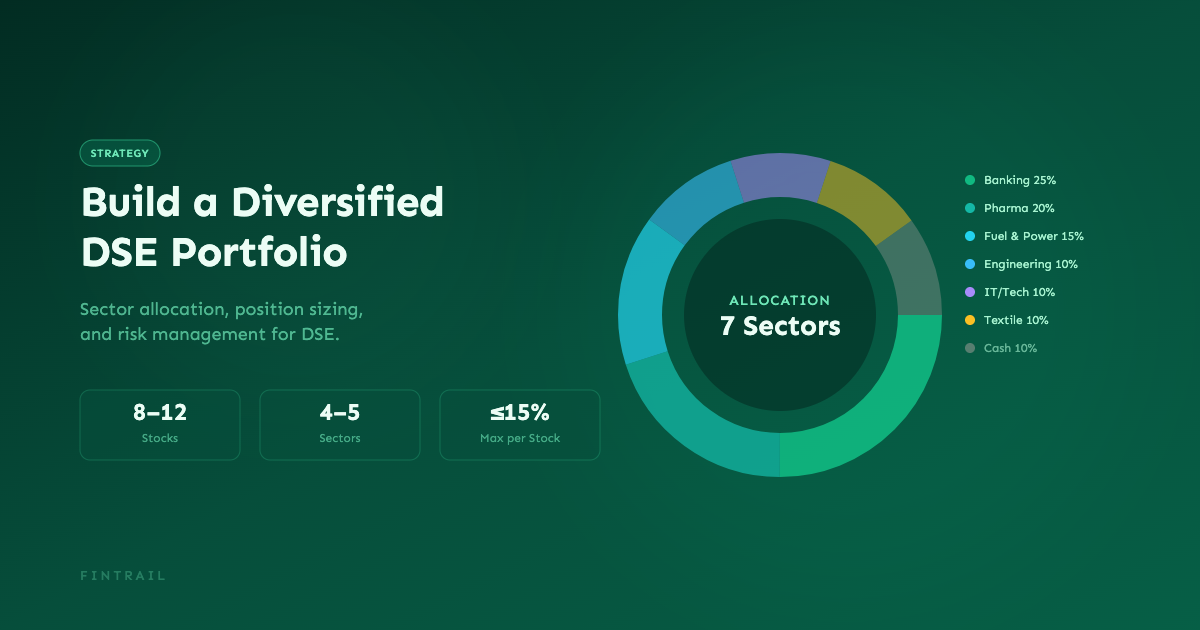
Here is how you might allocate ৳2,00,000 across sectors and stocks:
Core Holdings (৳1,40,000 — 70%)
| Sector | Allocation | Amount | Rationale |
|---|---|---|---|
| Banking | 20% | ৳40,000 | Choose a top-tier private bank with consistent ROE above 10%, low NPL ratio, and a history of dividend payments. Banks are the backbone of DSE liquidity. |
| Pharmaceuticals | 20% | ৳40,000 | A leading pharma company with strong domestic sales, export growth, and consistent EPS growth. Pharma is defensive — people need medicine regardless of the economy. |
| Fuel & Power | 15% | ৳30,000 | A power generation or distribution company with stable regulated revenue and reliable dividends. Utility-like stability for your portfolio. |
| Telecom/Consumer | 15% | ৳30,000 | A company with strong brand, wide distribution, and recurring revenue. Consumer-facing businesses benefit directly from Bangladesh’s growing middle class. |
Satellite Holdings (৳40,000 — 20%)
| Sector | Allocation | Amount | Rationale |
|---|---|---|---|
| Technology/IT | 10% | ৳20,000 | A company with accelerating revenue growth, exposure to export markets, and a strong order pipeline. Higher risk but significant upside. |
| Engineering/Cement | 10% | ৳20,000 | A company positioned to benefit from infrastructure spending. Cyclical, but Bangladesh’s development trajectory supports long-term demand. |
Cash Reserve (৳20,000 — 10%)
Keep this in your brokerage account or a short-term savings instrument. This is not idle money — it is strategic reserve for buying during corrections.
How to Select Individual Stocks
For each slot in your allocation, screen for companies that meet these minimum criteria:
For core stocks:
- Market cap in the top 100 on DSE
- Positive EPS for at least 4 of the last 5 years
- Debt-to-equity ratio below 1.0 (except banks, where different rules apply)
- Dividend payment in at least 3 of the last 5 years
- Sponsor/director holding above 30%
For satellite stocks:
- Revenue growth above 15% annually over 3 years
- EPS growth above 20% annually
- Reasonable P/E relative to growth rate (PEG below 1.5)
- Positive cash flow from operations
Do not rush this process. It might take a week or two of research to identify 6-8 stocks that genuinely meet your criteria. That is fine. The quality of your stock selection matters far more than the speed.
For an in-depth look at diversification, see our comprehensive portfolio guide.
The Buying Process: Practical Steps
Once you have your shortlist, here is how to actually execute:
Step 1: Don’t Buy Everything at Once
Even with ৳2,00,000, spread your purchases over 2-3 months. This gives you the benefit of different entry prices and lets you adjust if you learn something new about a company.
- Month 1: Buy your two strongest core positions (banking + pharma) — ৳80,000
- Month 2: Add fuel/power and consumer positions — ৳60,000
- Month 3: Add satellite positions — ৳40,000
- Keep ৳20,000 as cash reserve
Step 2: Use Limit Orders
Never buy at market price during the first 30 minutes of trading — prices are volatile at the open. Place limit orders at or slightly below the current price. If the order does not fill today, try again tomorrow. Patience at the buying stage saves you money.
Step 3: Record Everything
For each purchase, note:
- Date of purchase
- Number of shares
- Price per share
- Total cost including commission
- Your reason for buying
This record will be invaluable later when you review your decisions and learn from them.
What to Do After Buying
Month 1-3: Resist the Urge to Tinker
Your portfolio will fluctuate. Some stocks will go up, some will go down. This is completely normal. Do not sell a stock because it dropped 5% in its first week. Do not buy more just because something went up 10%.
Quarterly Review
Every three months, check:
- Have any companies reported earnings? Are they in line with expectations?
- Has any company’s fundamental story changed (management change, regulatory issue, loss of a major customer)?
- Is any single position above 15% of your portfolio? If so, consider trimming.
- Is any sector above 30%? Rebalance if needed.
Monthly Investment
If you can add ৳10,000-15,000 per month, do so. Direct new money toward whichever sector or stock is currently below your target allocation. This naturally implements a buy-low strategy.
Common First Portfolio Mistakes
Buying too many stocks. With ৳2,00,000, owning more than 6-8 stocks spreads you too thin. Each position becomes too small to matter. Focus on quality over quantity.
Concentrating in one sector. Buying three bank stocks is not diversification — it is three bets on the same sector. Spread across genuinely different industries.
Chasing recent winners. The stock that went up 40% last month is probably not the best buy today. Look at fundamentals, not recent price charts.
Ignoring transaction costs. Brokerage commissions, CDBL charges, and taxes add up. If you buy ৳5,000 worth of a stock, the commission alone might eat 2-3% of your investment. Keep individual position sizes meaningful — at least ৳20,000-30,000 each.
No exit plan. Before you buy, decide under what conditions you would sell. Not a price target — a fundamental trigger. “I will sell if earnings decline for three consecutive quarters” is a better exit plan than “I will sell if the price drops 20%.”
Scaling Up Over Time
Your first ৳2,00,000 portfolio is a foundation. As you add to it over months and years, the structure evolves:
- At ৳5,00,000, you can comfortably hold 8-10 stocks with meaningful positions
- At ৳10,00,000, you can add exposure to smaller, higher-growth companies
- At ৳25,00,000+, you might consider separating into a dividend-focused portfolio and a growth-focused portfolio
But the principles remain the same: diversify across sectors, maintain position limits, keep a cash reserve, and invest regularly.
The best portfolio is one you understand, trust, and can stick with through market ups and downs. Start building yours today.
Think About This
-
If you had ৳2,00,000 to invest today, how would your allocation differ from the sample above — and why? What sectors or companies do you understand best?
-
Why is it better to spread your purchases over 2-3 months instead of buying everything on one day? What risks does this reduce?
-
You buy a stock at ৳85 and it drops to ৳70 within a month, but the company just reported 20% earnings growth. What would you do, and what additional information would help you decide?