“Don’t put all your eggs in one basket” is perhaps the oldest investment advice — and it remains the most important. Diversification is your best defense against the unpredictable nature of the stock market, and it’s especially relevant for DSE investors.
Why Diversification Matters
The DSE has seen individual stocks drop 30–50% in a matter of weeks, even when the broader market was stable. If your entire portfolio was concentrated in that one stock, the damage would be devastating. Diversification ensures that poor performance in one holding doesn’t sink your entire investment.
The Core Principles
1. Sector Diversification
The DSE lists companies across many sectors. A well-diversified portfolio should span at least 4–5 different sectors:
- Banking & Financial Institutions — The backbone of DSE, highly liquid
- Pharmaceuticals — Defensive sector with consistent domestic demand
- Fuel & Power — Stable cash flows, often good dividend payers
- Engineering — Tied to infrastructure development and economic growth
- Textiles & Garments — Export-driven, benefits from global demand
- Cement — Cyclical but tracks construction activity
- IT & Technology — Emerging sector with growth potential
- Food & Allied — Defensive, benefits from population growth
2. Size Diversification
Mix large-cap, mid-cap, and small-cap stocks:
- Large-cap (top 30 by market cap) — Stability, liquidity, lower risk
- Mid-cap — Balance of growth and stability
- Small-cap — Higher growth potential but also higher risk and lower liquidity
A sensible split might be 50% large-cap, 30% mid-cap, and 20% small-cap.
3. Position Sizing
No single stock should dominate your portfolio. A good rule of thumb:
- Maximum 10–15% in any single stock
- Maximum 25–30% in any single sector
- At least 8–12 stocks for meaningful diversification
Building Your Portfolio: A Step-by-Step Approach
Step 1: Define Your Goals
Are you investing for long-term wealth building, regular dividend income, or medium-term capital gains? Your goal shapes your allocation.
Step 2: Set Your Budget
Decide how much you’ll invest initially and how much you’ll add monthly. Consistent monthly investments (dollar-cost averaging) reduce the impact of market timing.
Step 3: Select Your Core Holdings
Start with 3–4 strong, well-established companies from different sectors. These are your “anchor” stocks — companies with strong fundamentals, consistent earnings, and preferably a history of paying dividends.
Look for:
- Consistent revenue and earnings growth over 3–5 years
- Reasonable P/E ratio relative to the sector
- Strong balance sheet (low debt-to-equity)
- Regular dividend payments
- High sponsor/director holdings
Step 4: Add Growth Positions
Once your core is established, allocate 20–30% to growth stocks — companies with above-average earnings growth, expanding market share, or in emerging sectors. These carry more risk but offer higher potential returns.
Step 5: Keep Some Cash
Maintain 5–10% in cash or near-cash. This gives you the flexibility to buy when good opportunities arise, especially during market corrections.
A Sample Portfolio Structure
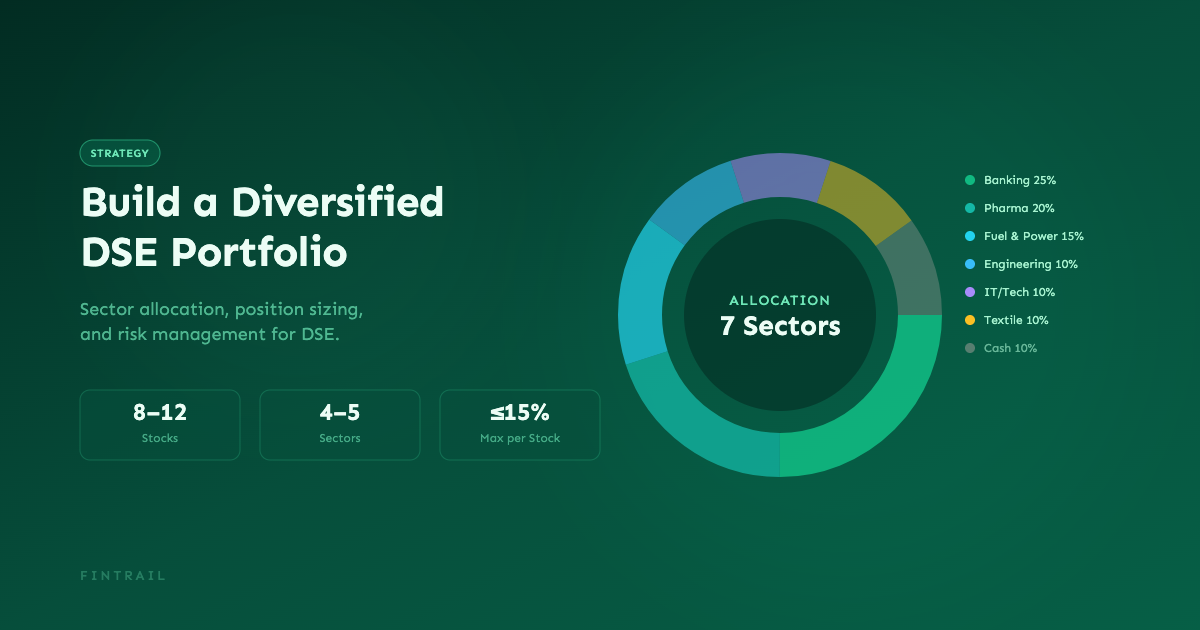
Here’s an example allocation for a ৳5,00,000 portfolio:
| Sector | Allocation | Amount |
|---|---|---|
| Banking (2 stocks) | 25% | ৳1,25,000 |
| Pharmaceuticals (2 stocks) | 20% | ৳1,00,000 |
| Fuel & Power (1 stock) | 15% | ৳75,000 |
| Engineering (1 stock) | 10% | ৳50,000 |
| IT/Technology (1 stock) | 10% | ৳50,000 |
| Textile (1 stock) | 10% | ৳50,000 |
| Cash reserve | 10% | ৳50,000 |
When to Rebalance
Review your portfolio quarterly. If any position has grown to exceed 15% of your total portfolio or any sector exceeds 30%, consider trimming and reallocating. Rebalancing forces you to sell high and buy low — exactly what you should be doing.
Common Diversification Mistakes
- Over-diversification — Owning 30+ stocks makes it impossible to track them all and dilutes returns. Stick to 8–15 stocks.
- False diversification — Owning 5 bank stocks isn’t diversification. Spread across sectors, not just names.
- Ignoring correlation — Some sectors move together (e.g., banking and insurance). True diversification means uncorrelated holdings.
- Chasing variety — Don’t buy a bad stock just to fill a sector quota. Quality always comes first.
Track Everything
Diversification only works if you actually monitor and maintain it. Use FinTrail to track your portfolio allocation by sector, monitor individual stock performance, and get alerts when positions need rebalancing. Real-time tracking makes it easy to see if your portfolio is drifting from your target allocation.
Building a diversified portfolio isn’t glamorous, but it’s the foundation of successful long-term investing. Start with strong fundamentals, spread your risk, and let time do the heavy lifting.