You understand what a stock market is and how the DSE works. Now it is time to get practical. Before you can buy a single share on the Dhaka Stock Exchange, you need two things: a Beneficiary Owner (BO) account and a relationship with a licensed stockbroker.
This post walks you through the entire process.
What Is a BO Account?
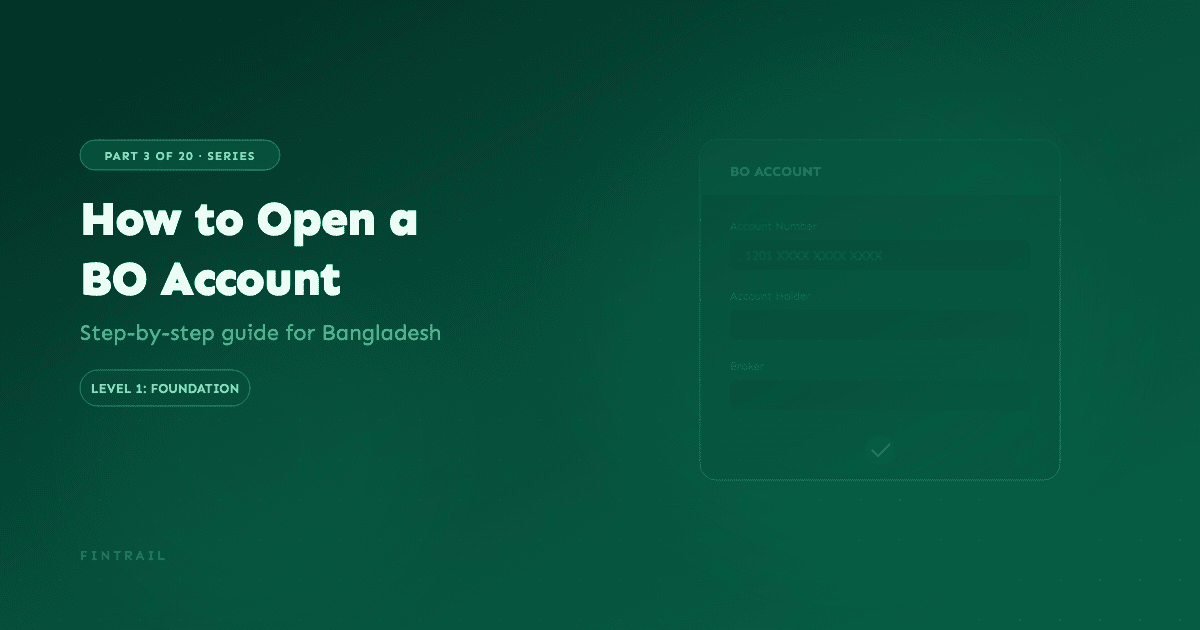
A BO account is your personal electronic account where your shares are held. It is maintained by the Central Depository Bangladesh Limited (CDBL) and is the digital equivalent of the old paper share certificates.
Every share you buy gets credited to your BO account. Every share you sell gets debited. Think of it as a bank account, but for shares instead of cash. Your BO account has a unique 16-digit number that identifies you in the depository system.
You cannot open a BO account directly with CDBL. Instead, you open it through a Depository Participant (DP) — which is almost always your stockbroker.
Step 1: Choose a Stockbroker
Your stockbroker is your gateway to the DSE. All brokers must be licensed by BSEC, but they differ significantly in quality. Here is what to evaluate:
Commission Rates
Brokers charge a commission on every trade, typically ranging from 0.20% to 0.50% of the transaction value. Some brokers offer lower rates for higher-volume traders or for online trades.
For perspective: if you buy ৳1,00,000 worth of shares with a broker charging 0.30%, your commission is ৳300. This applies to both buying and selling, so a round trip costs ৳600 in commissions alone.
Trading Platform
Some brokers offer modern online trading platforms or mobile apps where you can place orders, view charts, and monitor your portfolio. Others still rely heavily on phone-based trading. For a new investor, a broker with a functional online platform is strongly recommended — it gives you control and transparency.
Customer Support
When you are starting out, you will have questions. Test a broker’s support before committing. Call their help desk. Visit their office. See how responsive they are.
Reputation and Track Record
Ask other investors about their experiences. Check BSEC’s website for any disciplinary actions against the broker. A well-established broker with years of operation is generally safer than a new, unknown one.
Branch Network
If you prefer in-person service, consider a broker with a branch near you. Many major brokers have offices in Dhaka, Chittagong, Sylhet, and other divisional cities.
Step 2: Gather Your Documents
To open a BO account, you will typically need:
- National ID Card (NID) — This is mandatory. A photocopy of your smart NID card, both sides.
- TIN Certificate — Your Tax Identification Number certificate from the National Board of Revenue. This is required for all BO account holders.
- Bank Account Information — A photocopy of a bank cheque or statement showing your account number, name, and bank branch.
- Passport-size Photographs — Usually 2–3 copies. Some brokers accept digital photos.
- Nominee Information — You will name a nominee who can claim your shares in the event of your death. They will need their NID copy and photographs too.
- Proof of Address — A utility bill or bank statement showing your current address.
If you are a joint account holder, both parties need to provide their documents.
Step 3: Fill Out the Application
Visit your chosen broker’s office or, if available, use their online application process. You will fill out:
- BO Account Opening Form — Personal details, bank information, nominee details.
- Client Agreement — This outlines the terms of your relationship with the broker, including commission rates and responsibilities.
- Know Your Client (KYC) Form — Required by BSEC for anti-money laundering compliance.
Read the client agreement carefully. Pay attention to commission rates, margin facilities, and any fees for account maintenance.
Step 4: Fund Your Account
Once your BO account is approved — which typically takes 3–7 business days — you need to deposit money into your broker’s client account before you can trade. Common funding methods include:
- Bank transfer to your broker’s designated client account
- Cheque deposit at your broker’s office
- Online banking transfer (if your broker supports it)
How much do you need to start? There is no legal minimum, but practically:
- You can start with as little as ৳5,000–৳10,000.
- A more practical starting amount is ৳25,000–৳50,000, which lets you buy a few different stocks and begin learning about diversification.
- Do not invest money you cannot afford to lose, especially while you are learning.
Understanding the Costs
Trading on the DSE involves several costs beyond the share price:
| Cost | Rate | Paid To |
|---|---|---|
| Brokerage commission | 0.20%–0.50% | Your broker |
| BSEC fee | 0.015% | BSEC |
| DSE transaction fee | 0.015% | DSE |
| CDBL fee | 0.01% | CDBL |
| Capital gains tax | 0% (for gains up to ৳50 lakh/year) | NBR |
The total cost per trade (excluding brokerage) is approximately 0.04%. With brokerage, a typical all-in cost is around 0.25%–0.55% per side, or 0.50%–1.10% for a buy-and-sell round trip.
For long-term investors, these costs are manageable. For frequent traders, they add up fast — another reason why a buy-and-hold approach often outperforms active trading for most people.
Annual BO Account Charges
CDBL charges an annual maintenance fee for your BO account, typically around ৳300–৳500. Your broker may charge additional account maintenance fees. Ask about these upfront.
Online vs. Offline Trading
Most modern brokers in Bangladesh now offer both options:
Online trading lets you place orders from your computer or phone during market hours. You see real-time prices, can set limit orders, and maintain control over your decisions. This is the recommended approach for anyone comfortable with technology.
Offline (phone) trading means you call your broker and tell them what to buy or sell. They execute the order on your behalf. This is slower, less transparent, and more prone to miscommunication, but some investors still prefer it.
If you go with online trading, make sure you:
- Set a strong password and enable two-factor authentication if available
- Never share your trading credentials with anyone
- Log out after each session on shared devices
Common Mistakes When Opening an Account
- Choosing a broker based solely on low commissions — The cheapest broker is not always the best. Platform quality, reliability, and support matter more.
- Not reading the client agreement — Understand your rights and obligations before signing.
- Skipping the TIN certificate — Some people delay getting a TIN. Do it early — you need it, and it is straightforward to obtain from the NBR website.
- Funding with money you need short-term — Only invest what you can set aside for at least 1–2 years.
What Is Next
Your BO account is open, funded, and ready. In the next post, we will cover how to actually place your first trade — order types, market hours, what happens after you click “buy,” and how settlement works.
Think About This
- If two brokers charge 0.25% and 0.40% commission respectively, how much would you save over a year if you make ৳10 lakh in total trades? At what point does the difference become meaningful?
- Why do you think BSEC requires every investor to have a TIN certificate? What does this tell you about the relationship between investing and the tax system?
- You have ৳30,000 to start investing. Would you put it all in one stock or split it across three? What are the trade-offs of each approach, considering the commission costs you just learned about?